Ballerina Skeleton Embroidery Design
First Impressions: Spooky Charm, Not Just a Gimmick
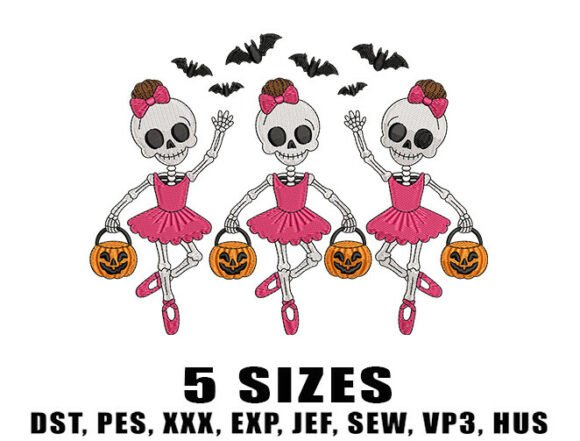
When I opened the Ballerina Skeleton Embroidery Design file, I didn’t see a Halloween cliché—I saw balance. Three skeleton ballerinas, each with a distinct pose, pink tutus, delicate bows, and cheerful pumpkin buckets. It’s playful without being cutesy, eerie without being scary. That duality is rare—and valuable—for small business owners who need designs that appeal across age groups and contexts. As a designer who regularly selects embroidery files for boutique baby onesies, holiday aprons, and Etsy sweatshirt collections, I immediately pictured this stitched on a soft heather-gray tote or a blush-pink baby blanket. The layout feels intentional: centered but not stiff, rhythmic but not repetitive. No forced symmetry—just three characters with gentle visual weight distribution.
A Real-World Test: Stitching It on a Linen Tea Towel
Last week, I prepped a batch of linen tea towels for a local kitchen boutique’s Halloween collection. I chose the 3.8-inch size of the Ballerina Skeleton Embroidery Design—not too large to overwhelm the fabric, not so small that details vanish. On medium-weight linen with tear-away + light cutaway stabilizer, the design stitched cleanly. The satin-stitched bows held their shape; the fill-stitched tutus had enough texture to read as fabric, not flat color blocks. Most importantly, the pumpkin buckets retained legibility—the curved stems and subtle facial expressions stayed crisp. Customers responded strongly to photos of the finished towel in mockups: “Whimsical,” “not too spooky,” “perfect for my witchy-but-wholesome brand.” That’s the real win—not just technical execution, but emotional resonance.
Where It Shines (and Where It Needs Care)
The Ballerina Skeleton Embroidery Design thrives on stable, medium-to-heavy fabrics: cotton twill for patches, fleece-lined sweatshirts, canvas tote bags, and structured aprons. Its charm translates beautifully to baby embroidery—think onesies or burp cloths—because the scale reads as gentle, not grotesque. For custom apparel, it works especially well on crewnecks and relaxed-fit tees where movement won’t distort the stitching.
But be thoughtful with placement and substrate:
- Thin or stretchy fabrics (like lightweight jersey or rayon blends) need extra stabilizer support—especially under the dense fill areas of the tutus. Without it, you’ll get puckering or thread pull.
- Curved surfaces like caps require careful hooping and possibly reducing the design size—those bow details can blur if stretched over a dome.
- Dark fabrics demand high-contrast thread choices. Pink thread on black works, but test first: some pinks dull or bleed visually. A soft rose or magenta often reads truer than bubblegum pink.
- Tiny corners—like the tips of the pumpkin stems or bow ends—can fray or skip on low-tension machines. Always run a test stitch on scrap before committing to your final piece.
Design Integrity Meets Commercial Practicality
This isn’t just a fun graphic—it’s a smart commercial embroidery file. The Ballerina Skeleton Embroidery Design avoids over-detail that would collapse at smaller sizes, yet holds character even when scaled up. That flexibility matters for craft businesses juggling multiple product lines: same file, five sizes, one cohesive aesthetic. I used the smallest version (1 inch) for embroidered iron-on patches on denim jackets—clean, recognizable, and quick to stitch. The largest worked on pillow covers without looking cartoonish. And because the composition is self-contained (no awkward cut-offs or trailing elements), it integrates smoothly into printable mockups for Etsy listings or social previews.
For Etsy sellers and handmade shop owners, this design supports brand consistency. It doesn’t scream “Halloween only”—it whispers “seasonal charm with personality.” That opens doors: a baby shower gift in October? A boutique’s year-round “spooky-cute” line? A wedding favor for a gothic garden party? Yes—if styled intentionally.
Designer Notes You’ll Actually Use
Before stitching your first Ballerina Skeleton Embroidery Design, do these five things:
- Test on scrap fabric matching your final substrate—even if it’s “just linen,” grain direction and finish vary.
- Check thread color contrast in natural light and on camera. Pink on light gray reads differently than pink on oatmeal.
- Review stitch density in your embroidery software. If fill areas look overly dense, consider reducing density by 5–10% for breathable fabrics like cotton poplin.
- Confirm hoop size compatibility—especially if using multi-position hoops or embroidery frames with tight clearance.
- Verify licensing for your use case. If you’re selling finished products (like embroidered sweatshirts), confirm the file permits commercial embroidery. If reselling digital files, check redistribution rights.
Also: try stitching it in monochrome. A black-and-white version on cream fabric reads as vintage illustration—not Halloween—and expands its lifespan beyond October.
Final Thought: It’s Not About the Skeletons—It’s About the Story
What makes the Ballerina Skeleton Embroidery Design stand out isn’t the novelty of dancing bones—it’s how it invites warmth into a traditionally edgy theme. When I stitched it on a baby blanket for a friend’s newborn (born October 29th), the reaction wasn’t “How morbid!”—it was “She’s going to love this little dance crew.” That emotional lift is what sells handmade products. It builds trust: customers sense care in the design choice, not just trend-chasing. For embroidery designers and creative entrepreneurs, that’s the quiet power of a well-judged machine embroidery design—it doesn’t just decorate fabric. It deepens connection.