Ukrainian Traditional Folk Embroidery
First Impression: Bold, Symbolic, and Instantly Recognizable
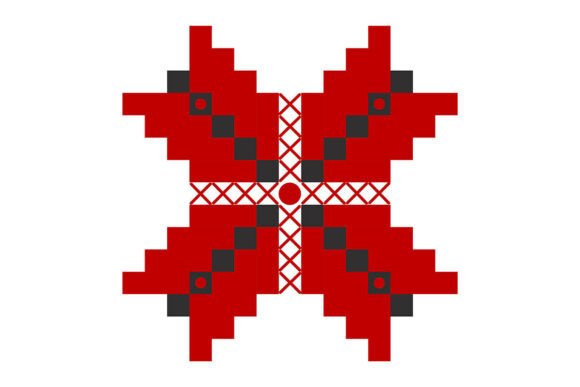
When I unzipped the folder and saw Ukrainian Traditional Folk Embroidery, my eye locked in immediately. Black and red — no gradients, no outlines, just strong, intentional contrast. The symmetrical four-petal flower with a central cross reads as both ancient and urgent. It’s not cute. Not rustic. Not minimalist. It’s bold and ceremonial, with the quiet confidence of national symbolism. At a craft fair booth buzzing with pastels and whimsy, this design stops people mid-stride. That’s rare — and valuable.
Where It Shines on Craft Fair & Handmade Products
This isn’t a “background filler” motif. Ukrainian Traditional Folk Embroidery commands attention — but only where it’s given room to breathe. Here’s how it performs across key handmade categories:
- Tote bag design: Perfect centered on the front panel. Large-scale stitching reads cleanly from 6 feet away. Customers associate the motif with intentionality — not decoration, but meaning.
- Apron embroidery: Ideal above the pocket or centered on the bib. The symmetry aligns beautifully with the human form, reinforcing craftsmanship over trendiness.
- Tea towel embroidery: Works best on high-thread-count linen or cotton — avoid heavily textured towels. On smooth weaves, the clean lines pop without distortion.
- Embroidered patch: Excellent candidate. Its compact geometry (four petals + cross) scales down well to 2.5–3 inches without losing legibility. Great for jackets, bags, or kids’ caps.
- Pillow cover & small pouch: Strong focal point when placed front-and-center. Avoid corner placements — this motif demands centrality.
- Caps & curved surfaces: Use caution. The symmetry can warp on domed crowns unless digitized with curve compensation. Test first.
- Printable mockup & Etsy listing: Highly photogenic. The black-and-red palette photographs crisply on white, cream, or natural linen — no color correction needed. Pair with warm lighting and shallow depth of field for instant boutique appeal.
What Makes It Sell — And What Requires Care
Ukrainian Traditional Folk Embroidery succeeds because it balances cultural resonance with visual simplicity. At a glance, customers understand it’s hand-rooted, meaningful, and made with care — even before reading your booth sign. That emotional shorthand is gold at a craft fair.
But practicality matters just as much. As an embroidery designer, I checked for common pitfalls:
- Stitch density: Symmetrical motifs like this often pack tight fills near the center cross. Confirm spacing between satin columns — too dense risks puckering on lightweight fabrics.
- Small details: No tiny lettering or micro-lines here — good. But inspect the petal tips and cross arms at 100% zoom. If they’re under 1.2mm wide, they may vanish on tea towels or dark fabric.
- Fabric texture: Avoid heavy terry cloth, bouclé, or thick canvas. This design needs a stable, smooth surface to honor its precision.
- Thread colors: Black and red are classic — but verify contrast on your base fabric. Red thread can mute on burgundy linen; black fades into charcoal denim. Always test.
- Scale flexibility: Works beautifully large (6–8" on tote bags) and mid-size (3–4" on patches or aprons). Below 2", clarity drops — skip use on earrings or keychains.
Booth Impact & Brand Alignment
In my own booth setup last spring, I grouped three items featuring Ukrainian Traditional Folk Embroidery: a heavyweight linen tote, a matching tea towel folded beside a ceramic mug, and a set of embroidered patches displayed on a corkboard grid. That cluster drew more questions than any floral or typographic piece I carried. Why? Because it signaled intention. Customers didn’t ask “What does it mean?” — they asked “Can I get one in navy?” or “Do you offer custom sizing?” That shift — from curiosity to conversion — is what every handmade shop owner wants.
It also strengthens brand consistency. Whether you sell on Etsy, at farmers’ markets, or through local boutiques, this motif anchors your collection in authenticity. It doesn’t chase trends — it roots them.
Essential Embroidery Designer Notes Before Production
Before cutting fabric or loading your machine embroidery design, do these six things:
- Test the Ukrainian Traditional Folk Embroidery file on scrap fabric matching your final product — same weight, weave, and dye lot.
- Check thread contrast on your actual base fabric — not just your screen. Natural light changes everything.
- Review spacing between stitch elements, especially where petals meet the central cross. Tight gaps need stabilizer support.
- Confirm hoop size compatibility. Symmetry requires precise registration — don’t force it into a hoop smaller than recommended.
- Use cutaway or tear-away stabilizer based on fabric stretch. Linen and cotton blends usually need medium-weight cutaway for crisp definition.
- Create at least one real mockup — not digital. Photograph it in your booth lighting. Compare it side-by-side with your other top sellers. Does it hold its own?
And one non-negotiable: confirm commercial licensing. Since this is sold as a digital embroidery file in the Illustrations category under Graphics, verify whether your license permits finished-product resale — especially for physical craft fair products or Etsy listings. When in doubt, contact the creator directly. Protect your small shop product integrity from day one.
Final Thought: A Design That Carries Weight — In the Best Way
Ukrainian Traditional Folk Embroidery isn’t just another machine embroidery design. It’s a quiet statement — about heritage, resilience, and the power of line and symbol. For craft fair sellers and handmade entrepreneurs, it’s a rare asset: deeply meaningful, visually uncomplicated, and commercially versatile. Used thoughtfully — on the right fabric, at the right scale, with proper testing — it transforms a simple tote bag into a conversation starter, a tea towel into a keepsake, and your booth into a destination. That’s not just selling. That’s storytelling, stitched.